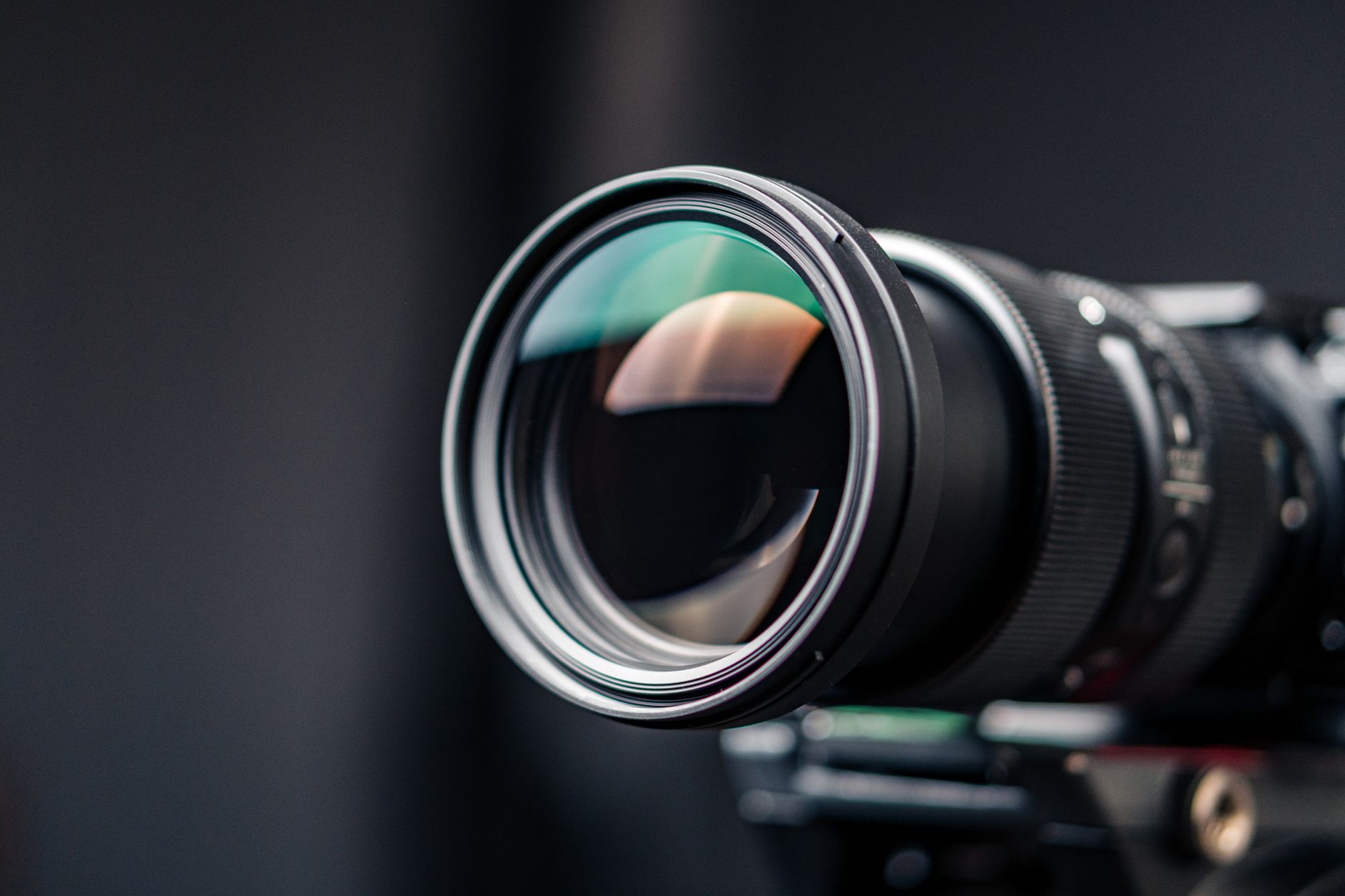
Understanding how lens focal length affects detection range is central to infrared module selection. A longer focal length does not make a detector more sensitive, but it projects a smaller angular field of view onto the same sensor, so a distant target occupies more pixels. For OEM engineers, the practical question is not simply whether a lens is “long enough,” but whether the lens, detector pitch, sensor resolution, aperture, optical quality, target contrast, atmosphere, stabilization, and processing chain together provide enough sampled target detail for the intended detection, recognition, or identification task.
How Lens Focal Length Affects Detection Range in Infrared Cameras
Focal length determines angular magnification. In an infrared camera, each detector pixel covers a small angle in the scene. This angle is commonly approximated by the instantaneous field of view, or IFOV:
IFOV ≈ pixel pitch / focal length
When pixel pitch and focal length use the same units, IFOV is expressed in radians. A 12 μm detector with a 50 mm lens has an approximate IFOV of 0.24 mrad. The same detector with a 100 mm lens has an approximate IFOV of 0.12 mrad. The longer lens therefore samples the scene at twice the angular detail, so the same target at the same range covers roughly twice as many pixels in each dimension.
A simplified range estimate follows from the same geometry:
Range ≈ target size × focal length / (pixel pitch × required target pixels)
This equation explains the first-order relationship. For a given target size and required pixel count, range scales almost linearly with focal length. Doubling focal length can roughly double geometric sampling range, provided that atmospheric attenuation, focus, vibration, diffraction, optical transmission, and signal-to-noise ratio remain adequate.
This is why a module such as the SPECTRA L06A 640×512 LWIR 12μm can be configured for different operating distances by changing lens focal length. The detector format and pitch define the sampling base; the lens defines how much of the scene is projected onto that detector. The trade-off is that every increase in focal length narrows the field of view unless sensor size increases at the same time.
Detection range calculations should also distinguish between detection, recognition, and identification. Detection only requires enough pixels to distinguish a possible target from background. Recognition requires more pixels to determine target class, such as person, vehicle, or animal. Identification requires still more detail. Traditional Johnson-criteria-style estimates are useful for early modeling, but they are probability-based approximations rather than guarantees for every scene.
Focal Length vs Field of View: What Changes?
Focal length and field of view are linked by sensor size. For a fixed detector format, a longer focal length produces a narrower horizontal and vertical field of view. This improves angular sampling but reduces scene coverage. A shorter lens covers more area and provides faster search capability, but distant targets occupy fewer pixels.
This relationship creates a common engineering trade-off. A perimeter camera may need a wide field of view to cover a gate, road, or fence segment, while a border-surveillance payload may need narrow-field detection at several kilometers. The optical configuration should be derived from the scene width to be covered at the required range, not from focal length alone.
For example, a 640×512 detector with a long lens may provide useful target sampling at distance, but it may also cover too narrow a scene for search. A 1280×1024 detector can use the same focal length while covering a wider field, or it can use a longer focal length while maintaining a usable field of view. This is one reason higher-resolution modules such as the SPECTRA M12A 1280×1024 Cooled MWIR are often considered when an OEM needs both range and operational coverage.
Field of view also affects operator workload and algorithm behavior. Narrow fields demand better pointing accuracy, tighter stabilization, and more deliberate scan patterns. In moving platforms, such as gimbals, vehicles, and UAVs, a narrow field increases sensitivity to vibration and angular rate. Even if the geometric range estimate is favorable, motion blur can reduce practical detection probability.
How Do Pixel Pitch and Sensor Resolution Change Detection Range?
Focal length cannot be evaluated independently of pixel pitch. Smaller pixels reduce IFOV for a given focal length, which can increase target sampling. A 7 μm detector behind a 35 mm lens has a similar angular sampling order to a 12 μm detector behind a 60 mm lens. This can help reduce optical package length and weight, but smaller pixels may also change sensitivity, full-well capacity, and optical design requirements.
Sensor resolution affects range in a different way. More pixels do not automatically increase the range of a single target if pixel pitch and focal length are unchanged. Instead, higher resolution increases total field coverage at the same IFOV, or allows an OEM to choose a narrower IFOV while retaining acceptable scene width. Resolution is therefore most valuable when system requirements include both long-range sampling and wide-area awareness.
The detector’s electro-optical performance still matters. Noise-equivalent temperature difference, non-uniformity correction quality, integration time, frame rate, and image processing all influence whether a sampled target is visible against background clutter. For objective camera characterization methods, the EMVA 1288 standard is a useful reference for separating sensor metrics such as noise, sensitivity, and dynamic range, even though system-level infrared detection range also depends on optics and scene conditions.
For OEM design, the practical step is to compute target pixels at range before comparing modules. A person-sized target, a small UAV, and a vehicle present very different critical dimensions. If the target’s minimum resolvable dimension is small, the system may need a longer lens, smaller pitch, higher resolution, better contrast, or a combination of these changes.
When to Use a Long Focal Length Lens
A long focal length lens is appropriate when the target is small in angular size, the required range is high, and the system can tolerate a narrower field of view. Common cases include fixed surveillance corridors, long-range vehicle observation, maritime approaches, airborne standoff imaging, and border monitoring. In these applications, geometric sampling is often the limiting factor in early design.
For Border Security systems, longer lenses are frequently used to extend detection and recognition distance along known lines of sight. The trade-off is that wide-area coverage may require scanning, multiple cameras, or a dual-field-of-view design. A single narrow thermal channel may detect distant targets but miss activity outside its field unless integrated into a broader sensor architecture.
On airborne and UAV platforms, long focal lengths must be balanced against payload size, mass, stabilization, and dwell time. A narrow field can support longer standoff observation, but only if the gimbal can hold line of sight accurately enough. In this context, optical range is not only a lens specification; it is a platform-level performance result.
Dual-band modules can help when detection and interpretation require more than one spectral view. A module such as the FUSION LV0625A 640×512+2560×1440 MIPI 35mm combines thermal and visible imaging paths, allowing system designers to use thermal contrast for detection and visible detail when illumination and weather permit. The lens choice still defines thermal target sampling; fusion does not remove the need for adequate IFOV.
What Other Parameters Limit Detection Range?
Focal length defines geometric sampling, but detection range is usually limited by several coupled parameters. Aperture and f-number determine how much radiation reaches the detector. A longer focal length lens with a high f-number may not improve practical range if the signal becomes too weak or diffraction and aberrations reduce contrast.
Optical transmission is especially important in infrared systems because lens materials, coatings, and waveband selection affect throughput. LWIR, MWIR, and SWIR systems experience different atmospheric windows and different sensitivity to humidity, aerosols, smoke, solar reflection, and target temperature. Cooled MWIR systems can offer strong sensitivity for some long-range applications, but they add size, power, startup time, and lifecycle considerations.
Atmosphere can dominate long-range performance. Heat shimmer, turbulence, fog, rain, dust, and humidity reduce contrast and resolution before the image reaches the lens. A range estimate based only on focal length and pixel pitch may overstate performance in low-contrast or high-attenuation conditions. OEM validation should therefore include representative temperature differences, backgrounds, weather, and platform motion.
Image processing and interfaces also matter, but they cannot recover detail that was never sampled. Contrast enhancement, temporal filtering, and AI classification can improve usability after a target is present in the image. They cannot make a one-pixel target reliably identifiable. Network and interoperability standards such as ONVIF Profiles are important for system integration, but they do not change the optical detection limit.
How Should OEMs Select Focal Length for Detection Range?
OEM selection should begin with target definition, not lens catalog browsing. The engineering team should define target size, required range, probability of detection, field of view, operating waveband, platform motion, environmental assumptions, and size-weight-power limits. From there, IFOV and target-pixel calculations can narrow the detector and lens choices.
A useful workflow is to calculate the pixel count across the target at the required range, compare it with the required detection, recognition, or identification threshold, and then check whether the resulting field of view still covers the operational scene. If the field becomes too narrow, the system may need a larger-format sensor, multiple fields of view, pan-tilt scanning, or a second imaging channel.
For compact long-wave systems, the focal length choice may be constrained by package depth and lens cost. For cooled MWIR systems, the choice may be driven by sensitivity, cold-shield compatibility, and long-range optics. For embedded AI systems, the image must still provide enough target pixels before classification is meaningful. Platforms such as the NEXUS LV0619B AI multi-band Ethernet/SDI should therefore be evaluated with the same optical sampling discipline as non-AI modules.
In short, focal length is one of the strongest levers for detection range, but it is not an isolated performance specification. OEM selection is most reliable when lens focal length, detector pitch, resolution, waveband, aperture, stabilization, processing, and environmental assumptions are modeled together and then confirmed through field testing.
FAQ
Does a longer focal length always increase infrared detection range?
A longer focal length increases target sampling for a given detector pitch, so it can increase detection range in geometric terms. It does not always improve practical range. If the lens has poor transmission, insufficient aperture, weak focus stability, excessive vibration sensitivity, or if the atmosphere removes target contrast, the realized range may be lower than the sampling calculation predicts.
What is the best focal length for long-range thermal detection?
There is no single best focal length. The correct value depends on target size, required range, detector pitch, sensor format, waveband, field of view, and platform constraints. Long-range systems often use longer lenses, but the final choice should maintain enough scene coverage and pointing stability for the application.
How many pixels are needed to detect a person with an infrared camera?
A person may be detectable with only a small number of pixels across the target under favorable contrast conditions, but recognition and identification require substantially more sampled detail. Engineers often use Johnson-criteria-style estimates during early design, then validate with real targets, backgrounds, weather, and processing settings.
Is focal length more important than thermal sensitivity?
Neither parameter replaces the other. Focal length determines how many pixels the target occupies, while sensitivity and noise performance determine whether the target contrast is measurable. A distant target with enough pixels can still be missed if thermal contrast is too low, and a sensitive detector cannot identify detail that is undersampled.
Can AI extend detection range beyond the lens limit?
AI can improve detection consistency, reduce operator workload, and classify targets when enough image information is present. It cannot bypass optical sampling limits. If the target is too small, blurred, or low-contrast in the input image, AI performance will be constrained by the same focal length, IFOV, and signal-to-noise limits as the rest of the imaging chain.