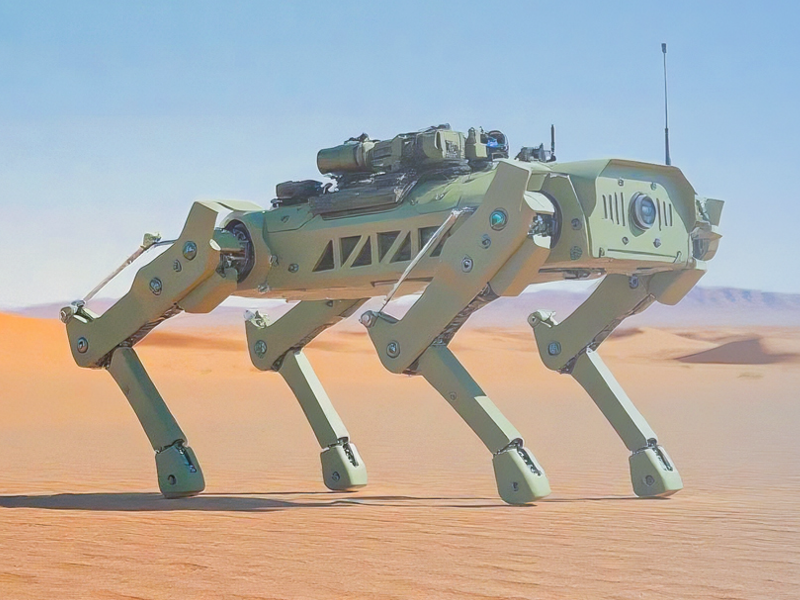
The next generation of intelligent devices — inspection robots, autonomous platforms, smart sensors — needs vision that doesn’t just capture images, but understands them. Edge AI vision moves perception from the data center into the device itself.

Traditional pipelines stream video to a host computer for analysis — costing bandwidth, latency, and power. AI-integrated imaging modules change the equation: with an onboard NPU, detection, classification, and tracking run directly inside the imaging module. The device receives decisions, not just pixels. That means robots that navigate by what they sense, devices that trigger events without a cloud round-trip, and systems that keep working when the network doesn’t.
Band choice matters as much as compute. Uncooled LWIR sees in total darkness and through smoke; SWIR sees through glass and water vapor and reads laser spots; dual-band fusion gives downstream models richer inputs than either band alone. Single-board integration — sensor, processing, and AI in one module — turns what used to be a multi-vendor integration project into a single component selection.

From warehouse AMRs and inspection robots to smart city terminals and industrial edge devices, AI-integrated imaging is the shortest path from “camera” to “capability.”
Typical Deployments
- Warehouse AMRs: autonomous mobile robots navigating and avoiding obstacles day and night
- Inspection robots: thermal-equipped patrol of plants, substations, and tunnels
- Smart city terminals: edge-AI sensors detecting events without a cloud round-trip
- Industrial edge devices: single-board vision that outputs decisions, not just pixels
Module Selection Guide
| Scenario | Module | Key figures |
|---|---|---|
| Robot perception & tracking | NEXUS LV0619B | On-board NPU detection, classification, tracking |
| Registered dual-band AI input | FUSION LV0625A | LWIR + visible on one chip |
| Darkness & smoke sensing | SPECTRA L06A (640×512) | Instant-on LWIR, ≤6 W |
| Through-glass & vapor imaging | SPECTRA S06A (SWIR) | 0.4–1.7 μm InGaAs, TEC-cooled |